
How a solar watch works: the technology that turns light into time (and never stops)
Don’t worry, we’re not talking about an old sundial, the kind you find in gardens with a rod and numbers painted on the ground. This is much better.
How is it possible that a light bulb is enough? Does the battery wear out? How often do you need to change the battery in a light-powered watch? Today we’re going to debunk myths and explain once and for all how solar watches work. Let’s open one up (mentally) and see what’s inside.
The principle: a quartz heart powered by light (like a plant, but without the pot)
The first thing you need to know is that a solar watch is not some strange creature. Inside, it’s a standard quartz watch. It has its integrated circuit, its stepper motor, and its crystal vibrating at 32,768 Hz. The precision, therefore, is the same as any quartz watch: seconds per month, not per day. How solar watches work doesn’t reinvent the wheel, it just improves how they are powered.
The difference lies in how they get energy. While a normal quartz watch uses a button cell battery that runs out and is thrown away, a solar watch has a rechargeable battery for solar watches (an accumulator) and a solar panel hidden under the dial. The solar charging system is the real star.
The process is simpler than it seems. Let’s break it down:
- Capture: Light (solar or artificial) enters through the watch crystal.
- Conversion: That light hits the photovoltaic panel under the dial. This is where the magic happens: the watch’s solar cell transforms photons into electricity.
- Storage: The generated electricity travels to a rechargeable solar battery, an accumulator that constantly recharges as long as there is light.
- Consumption: That battery powers the quartz movement. Always. Without rest. That’s why the power reserve of a solar watch can be so long.
In other words: your wrist has a tiny, self-regulating power station. As long as there’s light, there’s life. That’s how simple the solar watch mechanism is.

The dial: where the sun hides (without being noticed)
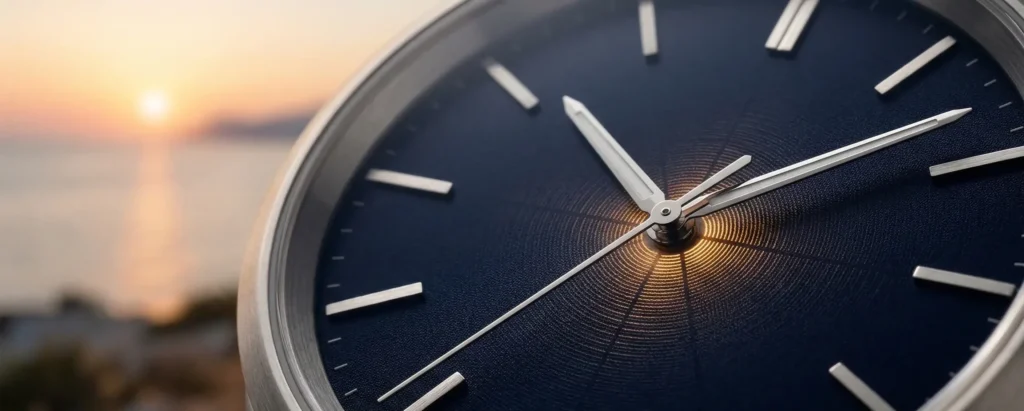
If you’ve ever wondered why solar watch dials aren’t transparent or don’t have an ugly visible panel, the answer lies in the design. Manufacturers have spent years perfecting this so that solar technology in watches is invisible.
The solar panel is under the dial, not on top of it. The dial has micro-perforations or is made of a semi-transparent material that lets enough light through for the watch’s solar cells to do their job, but to the naked eye, it looks completely opaque with the design intact. That’s why, when someone sees a modern photovoltaic watch, they don’t notice the difference until they’re told it runs on light.
The early designs, back in the 70s and 80s, did have visible panels because the technology wasn’t advanced enough to integrate them. But today, engineering has progressed so much that it’s possible to make an elegant solar watch that fits perfectly with classic aesthetics. Dials are designed with microscopic openings or translucent layers that let just enough light through, maintaining the appearance of a conventional watch.
There are no more aesthetic excuses. Whether you’re looking for a sports watch, a dive watch, or a classic dress watch, solar technology fits into all of them without leaving a visible trace.
The battery: the great forgotten (and the one that generates the most myths)
Here comes the part that creates the most doubt. The battery in a light-powered watch is not the standard button cell. It’s an accumulator for solar watches, usually lithium-ion, designed specifically to be recharged hundreds of times throughout its lifespan. Hence the recurring question: how long does a solar watch battery last?
Modern solar watch batteries have a lifespan of 10 to 20 years. It depends on usage, light exposure, and the model. It’s not a component you need to change every two years, far from it. That’s why knowing how to care for a solar watch is so important to maximize the accumulator’s life.
But be careful, there’s an important nuance: if the watch spends years shut in a dark drawer, the battery can discharge completely below a critical level and deteriorate irreversibly. That’s what happens when you have a solar watch without light for too long. The accumulator “forgets” how to hold a charge.
The recommendation is simple: even if you don’t wear your light-powered watch, leave it in the light (natural, but not direct, scorching sun) from time to time. On a shelf with some daylight is enough. This way, the accumulator doesn’t suffer and you maximize its life. If you’re concerned, look for information on how to extend the life of a solar watch battery and you’ll see it’s easier than you think: just give it some light regularly.
And if one day, after many years, the battery finally gives up, you can change a solar watch battery. It’s not a disposable watch. A watchmaker with the right tools can open it, replace the accumulator with a new one, and your watch will come back to life for another 15 or 20 years. It’s a maintenance operation, like changing the shock absorbers on a car.
Charging: how much light does it need to work?
Another widespread belief: “a solar watch needs direct sunlight all the time.” False. Artificial light works perfectly. The charging speed is what differs. That’s why many people wonder how to charge a solar watch on a daily basis without relying on good weather.
To give you an idea, manufacturers often publish charging tables that are very illustrative:
- A sunny day outdoors (50,000 lux) can charge the watch for a day of use in just 8 minutes.
- If you’re in an office with fluorescent light (500 lux), you’ll need 8 hours to get the same energy for a day of operation.
- With domestic incandescent light (300 lux), the charging time is longer, but it’s still perfectly valid for keeping the watch operational.
The key is that as long as there is light, the watch is charging. That’s why it’s perfectly possible and recommended to charge a solar watch with artificial light without needing to see the sun. A desk lamp is more than enough. As a personal recommendation, we advise you not to use LED lights for charging, as the luminous power of an LED is lower than that of a filament bulb. And be careful with how you use a filament bulb, as being too close or under it for a long time could affect the watch’s components due to the intensity of the heat.
The most efficient solar movements can store energy for 6 months of operation in total darkness after a full charge. And some more advanced systems, up to 5 years if they enter a deep hibernation mode where the watch stops the hands but keeps the time in memory. We’re talking about a solar watch power reserve that is simply monstrous.
Daily use is very simple: if you wear the watch every day and don’t constantly cover it with your sleeve, it will never stop. The ambient light from the street, the office, or your home is more than enough to keep it at 100% all the time.
How do I know if it’s running out of light? The language of the second hands
Solar watches have their own language to communicate with you. When the charge is low, the second hand starts moving in 2-second intervals instead of 1. This is its energy-saving mode in solar watches, a visual warning signal.
If you see that strange dance (the second hand jumps, waits two seconds, jumps again), don’t panic. Your watch is telling you: “hey, I need a little light or I’ll stop.” Put it near a window or under a desk lamp, and in a few hours, it will return to its normal one-second tick-tock. This is the famous 2-second second hand in solar watches that surprises so much at first but is just a friendly warning about its charge status.
Technical advantages of the solar system (why it makes sense)
Beyond trends, the solar power system has objective advantages from a watch engineering standpoint. Here are the reasons why a solar watch is worthwhile if you value technology:
- Energy autonomy: The watch generates and stores its own energy. You don’t depend on external replacements or having to remember to buy batteries.
- Virtually no maintenance: By not having to open the case back every two years to change a battery, the watch’s water resistance remains intact for longer. Fewer manipulations, less risk of dust or moisture getting in.
- Sustainability: An eco-friendly solar watch reduces the number of disposable batteries that end up in the trash. Over its lifetime, you avoid throwing dozens of batteries into the environment.
- Movement longevity: Being essentially a quartz movement, the mechanical parts (the stepper motor and gear train) suffer minimal wear. With proper care, it can function perfectly for decades.
- Mature and reliable technology: The first experiments with solar watches date back to the 70s, and since the 90s, the technology has been completely perfected. It’s not an experimental invention; it’s a technology proven by millions of users worldwide for decades.

A bit of history: from the discovery of the photovoltaic effect to your wrist
Harnessing sunlight isn’t new. In fact, the story of how we came to have these watches on our wrists is fascinating and goes back several centuries.
Legend has it that in 214 BC, Archimedes used mirrors to concentrate the sun’s rays and set fire to Roman ships besieging Syracuse. A military feat using solar energy.
Much later, in 1838, at just 19 years old, the French physicist Alexandre-Edmond Becquerel discovered the photovoltaic effect. He noticed, almost by chance, that an electrolytic cell generated more electric current when light fell on one of its electrodes. He had discovered the basis of everything.
And in 1883, American inventor Charles Fritts created the first photovoltaic cell in history. It used selenium as a semiconductor material and barely achieved 1% efficiency, but it was the first step towards converting light into electricity in a controlled way.
In the 20th century, technology advanced. In the 70s, the first brands began experimenting with solar cells in wristwatches. The early designs were crude, with visible panels and limited efficiency, but they laid the groundwork. It was in the 90s that the technology made the definitive leap: panels became efficient enough to be hidden under the dial, and accumulators improved their capacity and lifespan. From that moment on, the modern solar watch, as we know it today, became an accessible and reliable reality.
Frequently asked questions about how it works (answered once and for all)
Throughout the article, common doubts have arisen. Let’s answer the most important ones clearly and directly.
- Does a solar watch only work with direct sunlight? No. Any light source, including artificial light (bulbs, fluorescents, LEDs), is valid. The charging speed varies, but artificial light is perfectly fine for daily use.
- How often does the battery need to be changed? The rechargeable battery (accumulator) has a lifespan of 10 to 20 years. After that time, it can be replaced by a watchmaker.
- What happens if the watch is without light for a long time? It will enter an energy-saving mode, stopping the hands to conserve the little charge it has left. If it receives light again, it will set itself to the correct time and resume normal operation. If the darkness is very prolonged (years), the battery may degrade.
- Do cold or heat affect its operation? Like any electronic device, extreme temperatures can temporarily affect precision or battery capacity. Under normal use conditions, there’s no problem.
- Can I wear a solar watch under a long sleeve? Yes, but if the sleeve is very dark and completely covers the dial, the watch won’t receive light while covered. Outdoors or indoors with the sleeve pulled back, it will charge without issue.
- Can a solar watch be charged behind glass? Yes, window glass lets through more than enough light to charge the watch. A car windshield works too.
The light that never goes out
The next time you look at your wrist, think about what’s inside. A tiny panel capturing photons. A battery storing that energy like treasure. A quartz crystal vibrating 32,768 times per second. All powered by the same light that comes through the window, the same light that illuminates your desk.
Your light-powered watch needs no winding, no disposable batteries. It only needs light. And light is almost always there. On the street, in your home, at the office, in a café. That’s why it works. That’s why it’s so ridiculously autonomous and reliable.
Now you truly know how a solar watch works. You know it’s not magic, it’s applied science. And you know that if you decide to get one, it will accompany you for a very, very long time. Asking for nothing. Just a little light.
Technical summary: how a solar watch works in 10 key points
For those who want a clear overview, here’s the definitive summary of everything we’ve seen about the technology behind it:
- Basic principle: a solar watch is a quartz watch that, instead of using a disposable battery, runs on a rechargeable battery (accumulator) powered by light.
- The solar panel: the watch dial hides a photovoltaic panel that converts light (solar or artificial) into electrical energy. The solar cells are invisibly integrated under the indices or the dial background.
- The accumulator: the rechargeable battery stores the generated energy. It’s the watch’s fuel tank. Its lifespan is 10 to 20 years and it can be replaced.
- Precision: being a quartz movement, the accuracy of a solar watch is the same as any quartz watch: seconds per month.
- Autonomy: the power reserve varies by model, but ranges from several months up to 5 years in total darkness after a full charge.
- Types of light: they work with any light source. You can charge a solar watch with artificial light without any problems. Sunlight is faster, but indoor light works too.
- Low battery indicator: when the charge is critical, the second hand moves every 2 seconds instead of 1. It’s the energy-saving mode warning that it needs light.
- Maintenance: it’s minimal. Just avoid prolonged total darkness. If not in use, just leave it in ambient light from time to time.
- History: the discovery of the photovoltaic effect in 1839 by Becquerel and the first experiments in the 70s laid the foundations for today’s technology, perfected since the 90s.
- Philosophy: a solar watch is not just a timekeeping instrument; it’s a small autonomous generator that turns light into energy without needing anything else.
Now you know everything about the engineering behind a solar-powered watch. A marvel of miniaturization that turns light into time, asking for nothing more. As long as there’s light, there’s time.


