
How a quartz watch works: the technology on your wrist (explained simply)
You’ve seen it a thousand times. Your quartz watch has been in the drawer for months, you take it out, set the time, and for the next two years it keeps time without losing a minute. Meanwhile, your automatic has been stopped since the first weekend you didn’t wear it.
But how does it do it? What does a quartz watch have inside that makes it so ridiculously accurate and so undemanding? Today we are going to explain once and for all how a quartz watch works from start to finish.
You don’t need to be an engineer to understand how these watches work. But once you understand it, you look at your wrist in a different way. Let’s take a look.
The heart of the quartz watch: a crystal vibrating 32,768 times per second
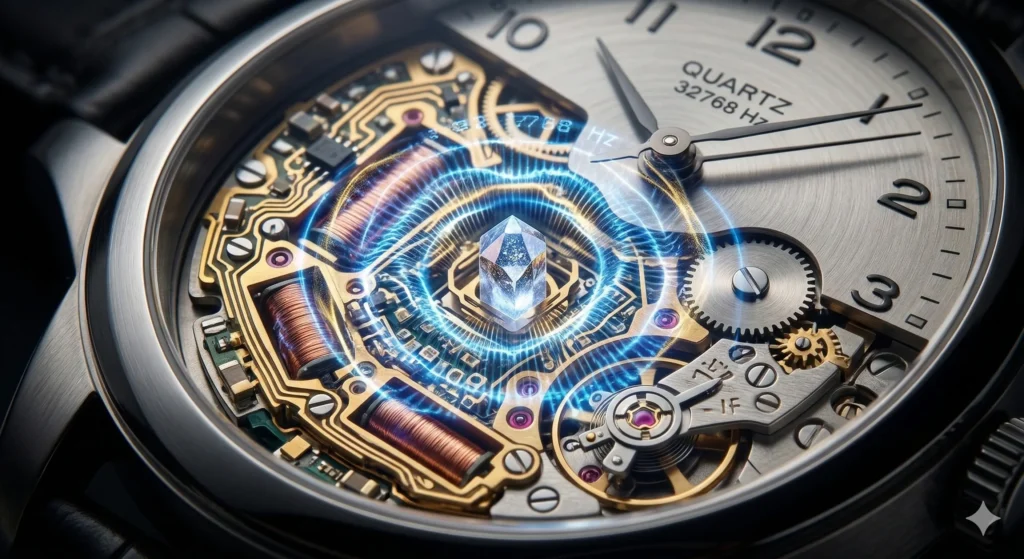
The name says it all. The heart of these watches is a small piece of quartz, a mineral composed of silicon dioxide. The same material as beach sand, but cut into a very specific shape and size: a tiny tuning fork.
What makes quartz special is a property called the piezoelectric effect. When you apply an electric current to this crystal, it deforms and begins to vibrate. And it always does so at the same frequency, like a perfect metronome. That’s why the piezoelectric system in watches is the basis of everything.
In watches, this frequency is 32,768 vibrations per second. It may seem like a random number, but it’s not: it’s a power of two (2¹⁵), which makes it easy for an electronic circuit to divide that frequency down to one pulse per second. This frequency of 32768 Hz has become the industry standard.
That is the basis of everything: a crystal that vibrates tirelessly as long as it has electricity, and a circuit that counts those vibrations. That, in essence, is how a quartz watch works at an atomic level.
The battery: the energy reservoir that keeps it alive (for years and years)
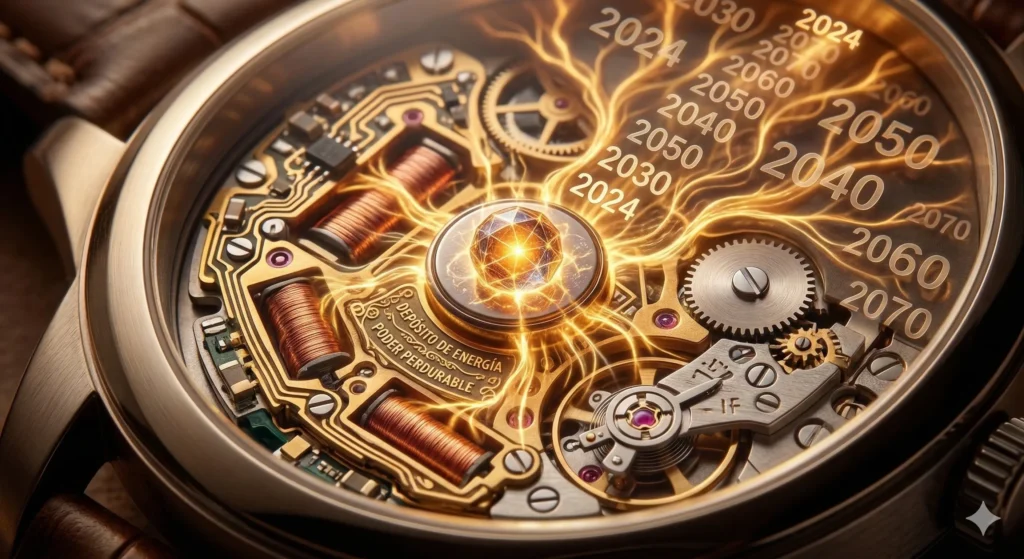
Quartz needs electricity to vibrate. That electricity comes from a small button cell battery, that silver coin you change every two or three years without giving it a second thought. This is why these watches are also called battery watches, although the term doesn’t do justice to what’s inside.
The impressive part isn’t the battery itself, but how little the whole system consumes. A typical quartz watch movement runs on 1.5 volts DC and consumes between 1 and 2 microamps. To give you an idea, a standard button cell has a capacity of about 200 milliamp-hours. That means it could power the watch for over 10 years if consumption were constant, but other factors shorten that lifespan.
The battery life of a quartz watch depends on the movement. The simplest ones, with just time and date, easily reach 3-4 years. Those with a chronograph, alarm, or illumination may need changing sooner, between 1 and 2 years. And those with features like “eco-drive” or kinetic ones use rechargeable batteries that can last the entire useful life of the watch. In any case, the operating cost of a quartz watch is minimal compared to any other electronic device.
The integrated circuit: the brain that converts vibrations into seconds
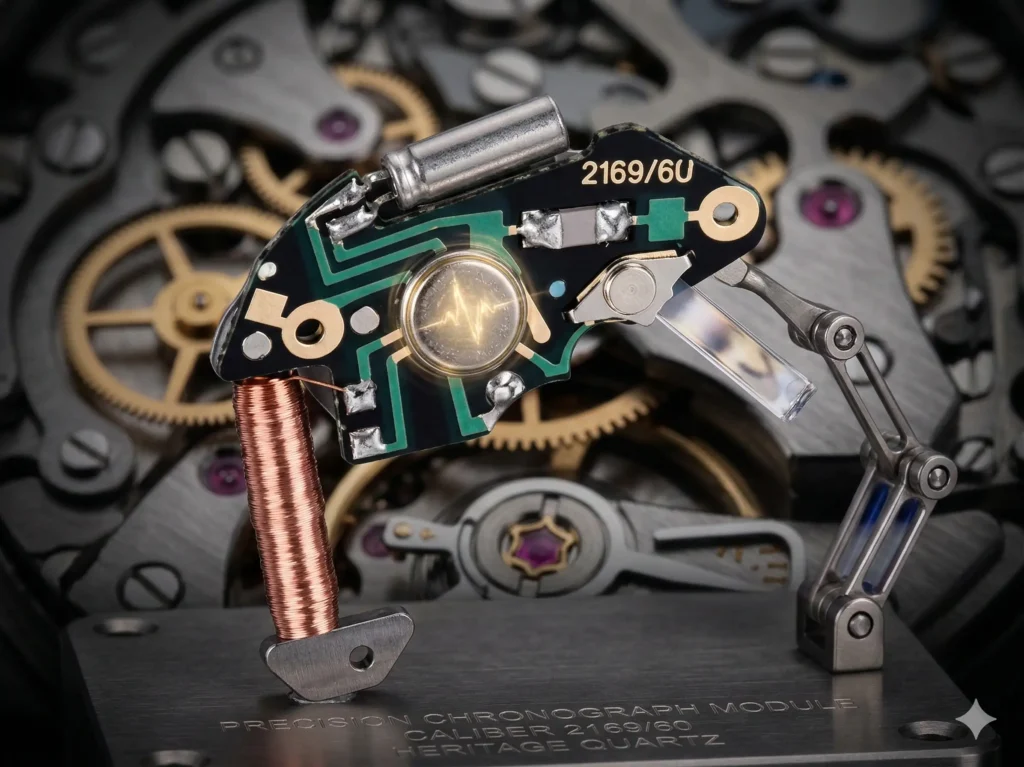
The crystal vibrates 32,768 times per second, but that’s useless if we can’t translate it into something useful. We need to convert those thousands of vibrations into a single pulse each second. That job is done by the integrated circuit, a tiny chip smaller than a lentil. It’s the brain that manages the entire quartz watch mechanism.
The circuit performs a constant mathematical operation: it divides the frequency by two, over and over, until it reaches 1 Hz, that is, one pulse per second. Since 32,768 is 2¹⁵, it needs 15 stages of division to get exactly one second. This accuracy of the quartz watch is the key to its reliability.
That signal, now converted into a regular and precise impulse, is what sends the order to the motor: “move.” Once per second. Always the same. Always exact.
The difference between a normal quartz watch and a high-end one lies in how they handle that circuit. Conventional quartz watches do not compensate for temperature changes, which slightly affect the crystal’s vibration. High-end ones, like the Grand Seiko 9F, include temperature compensation to keep the precision of the quartz watch accurate in both winter and summer. Some Japanese quartz calibers are true works of engineering.
The stepper motor: the muscle that moves the hands
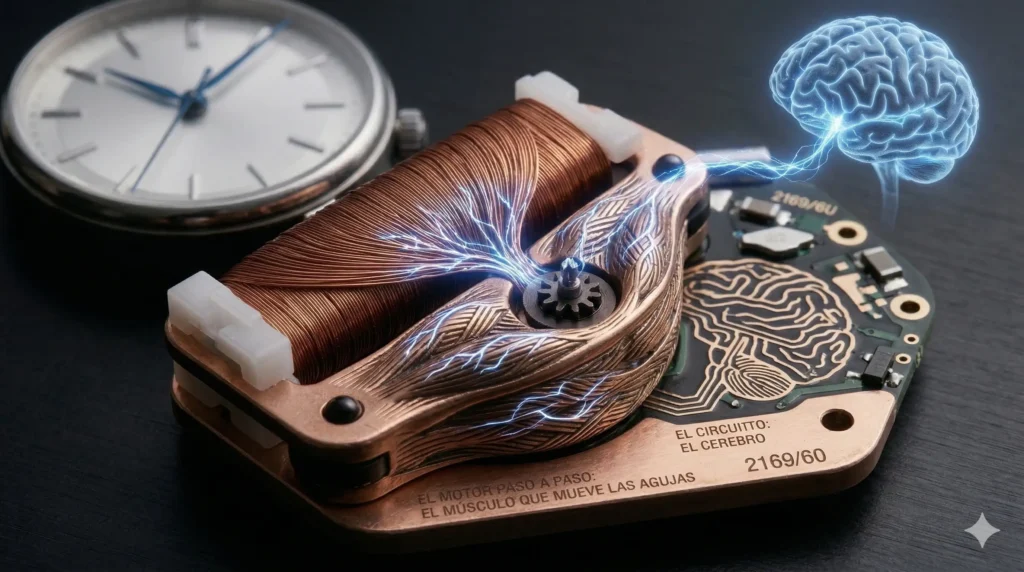
We now have the electrical command. Someone has to execute it. That someone is the stepper motor, a small electromagnetic device that transforms electricity into mechanical movement. It is the most visible part of the internal mechanism of a quartz watch.
The motor has a rotor, which is a magnet, and coils. When it receives the pulse from the circuit, it creates a magnetic field that rotates the rotor exactly 180 degrees. This rotation is transmitted through a tiny gear train until it reaches the hands.
In analog quartz watches, this is the only mechanical movement. Everything else is pure electronics. That’s why they can be so thin: they don’t need a huge mainspring barrel or a complex gear train like automatics. The parts of a quartz watch are far fewer than those of a mechanical one.
And that characteristic movement of the second hand, advancing in one-second jumps, is quartz’s signature. It’s not a flaw, it’s how it works: the motor only receives an impulse every second, so it moves, waits, moves, waits. Step by step, that’s how a quartz watch works in its most visible part.
Quartz precision in numbers: how much does it drift?
Let’s talk numbers. A well-adjusted automatic watch can have a deviation of between -4 and +6 seconds per day in high-end certified models. Normal ones run between -20 and +40 seconds per day. When comparing quartz watch vs automatic, the differences are abysmal.
A normal quartz watch, the kind that costs between 50 and 200 euros, typically has a deviation of about 15 seconds per month. That means in a year it might drift about 3 minutes, which is corrected the next time you change the time or the battery. This accuracy of the quartz watch is its main advantage.
A high-precision quartz watch, like those with temperature compensation, can have deviations of only 5-10 seconds per year. The Grand Seiko 9F, for example, is adjusted to drift less than 5 seconds per year. The Longines V.H.P. (Very High Precision) even less: +/- 5 seconds per year with a system that detects shocks and magnetic fields and automatically readjusts. We’re talking about a quartz watch accuracy that borders on the ridiculous.
The 32,768 Hz frequency is the most widespread because it offers the best balance between precision and energy consumption. There are movements that use higher frequencies for greater precision of quartz watches, but they consume more battery.
Advantages of quartz (and a few drawbacks)
Let’s get practical. The advantages of the quartz watch are many and obvious:
1. Superior precision: as we’ve just seen, there’s no comparison. A 20-euro quartz is more accurate than any mechanical watch in the world.
2. Virtually no maintenance: change the battery every few years and that’s it. No oiling, no regulating, no cleaning.
3. Durability: having fewer moving parts, they withstand shocks and wear better.
4. Price: generally, they are much more affordable. You can have a quality Swiss quartz watch for under 500 euros, unthinkable in mechanical.
5. Autonomy: leave it in a drawer for months and it works when you take it out. An automatic stops after 48 hours.
But they also have some drawbacks. The main one is that they have no “soul” for purists. They are cold, electronic, disposable in many cases. They also depend on a battery, and if it runs out and you don’t change it, the watch dies. And when the circuit or motor fails, it’s often not worth repairing because it costs more than buying a new one.
But within quartz watches, there are also grades. High-end quartz watches like the Grand Seiko, Citizen Chronomaster, or Longines V.H.P. are a different story. They have compensated circuits, more robust motors, hands that move with the smoothness of a mechanical (the second hand of the Grand Seiko 9F has a double-pulse system that eliminates the “stutter” of the second hand). These are high-end quartz movements that have nothing to envy in mechanical ones.
And then there are the solar vs traditional quartz watches, like the Citizen Eco-Drive or Seiko Kinetic. They never need a battery change (or every 10 years in the case of rechargeable batteries). They combine the best of both worlds: quartz precision with practically infinite autonomy. In the debate of quartz watch vs automatic vs solar, each has its place.
A bit of history: how quartz nearly killed traditional watchmaking
In 1969, Seiko launched the Astron, the first quartz wristwatch in history. It cost as much as a Toyota Corolla car of the era, but it was incredibly accurate: it lost only 5 seconds per month, when the best Swiss mechanical watches struggled to meet -4/+6 seconds per day. It was the first quartz watch in history and changed everything forever. From then on, understanding how a quartz watch works became key for an entire industry.
The Swiss watchmakers, who had dominated the world market for decades with their mechanical movements, didn’t see it coming. In a few years, Japanese quartz watches, cheaper to produce, more accurate, and with more functions, swept the market. It was the so-called quartz crisis.
Between 1970 and 1983, the number of workers in the Swiss watch industry fell from 90,000 to 28,000. Many century-old brands disappeared. Others sank economically. The impact of quartz on watchmaking was devastating.
Salvation came in 1983 with the Swatch. A fun, colorful, cheap quartz watch with lots of marketing that revolutionized the industry and saved what was left of the Swiss watchmaking tradition. Swiss quartz watches rose from their ashes thanks to this strategy.
Today, mechanical and quartz coexist in peace. Each has its audience, its reason for being, and its charm. When someone asks about quartz or automatic watch, the answer is no longer technical, it’s emotional.
Everything beats, even if electronically
The next time you look at your wrist, remember what’s inside. A tiny piece of sand vibrating 32,768 times per second. A chip counting tirelessly. A motor advancing step by step. All powered by a battery that barely uses energy. Now you truly know how a quartz watch works.
Your quartz watch doesn’t breathe like an automatic. It doesn’t have a ticking mechanical heart. But it has an electronic pulse, silent and relentless, that never stops as long as there’s battery.
It’s not a companion that depends on you. It’s a reliable friend who never asks anything in return. That’s why, when someone looks for information about quartz watches, what they’re really looking for is to understand why they work so well without asking for anything.
That is a quartz watch. That’s what you wear on your wrist without knowing it.
From theory to the wrist (even if online)
You now know how quartz vibrates. You know why it’s so accurate. You know it needs no maintenance or care. You know everything there is to know about that little machine on your wrist. You have learned how a quartz watch works from start to finish.
But knowing is not the same as feeling.
Because a watch, whether quartz or automatic, is chosen with the head, yes. But also with that strange feeling when you try it on and don’t want to take it off. With that moment when you check the time without needing to, just to look at it.
If you haven’t found that moment yet, here’s where to start looking. And remember: a watch isn’t found by searching. It’s found when you least expect it. But now, at least, you know what you’re looking for. You now understand what a quartz movement is, how it beats, and above all, how a quartz watch works in each of its components.
Summary: how a quartz watch works in 30 seconds
The essentials of the quartz watch mechanism, piece by piece. To finally understand what you’re wearing on your wrist.- ◆ Quartz crystal: Vibrates 32,768 times per second (piezoelectric effect). It is the heart of the system.
- ◆ Battery: Powers the crystal. Battery life is 2 to 4 years. In solar watches, it’s never changed.
- ◆ Integrated circuit: Counts the vibrations and converts them into one pulse per second. Hence the accuracy of the quartz watch.
- ◆ Stepper motor: Receives the pulse and moves the hands. This is why the second hand moves in jumps.
- ◆ Precision: 15 seconds per month (normal). High-precision quartz watches only 5 seconds per year.
- ◆ Maintenance: Change battery every 2-3 years and check gaskets. Nothing else.
- ◆ Difference with automatic: Quartz wins in precision and maintenance. The automatic wins in soul and craftsmanship. They don’t compete, they coexist.
- ◆ High-end: Grand Seiko 9F, Longines V.H.P., Citizen Eco-Drive. High-end quartz movements with compensated circuits.
- ◆ History: The first quartz watch (Seiko Astron, 1969) triggered the quartz crisis that nearly ended Swiss watchmaking.
In summary: A crystal that vibrates, a circuit that counts, a motor that advances, and a battery that powers it. That’s how simple how a quartz watch works is. The reliable friend that never fails.


