Skeleton Watches: The Truth
Behind the Visible Mechanism
This article is an informative guide on the history, craftsmanship, and market for skeleton watches. The historical information is based on industry sources and museum archives. Prices and references for current models are approximate and may vary. This does not constitute purchase or investment advice.
NAVIGATE THE ARTICLE:
If you've ever thought a skeleton watch is a modern invention, a passing fad to look "cool," or a whim of bored engineers, brace yourself.
You're about to discover the reality is far more interesting.
The origin of these watches had absolutely nothing to do with style. Or luxury. Or ostentation.
It was a teaching necessity.
Imagine Paris in 1760. Watchmakers were a secretive elite. Their knowledge was passed down from master to apprentice in dark, cluttered workshops. There was no YouTube. No manuals with 3D diagrams. There was no way to see the inside of a mechanism without taking it completely apart.
What Caron created as a workshop tool soon escaped the guild environment. The French aristocracy, always hungry for unique objects, discovered those "open" watches and saw something no jeweler could offer: the chance to look into the soul of the machine.
To see the heart beat.
The most brilliant student linked to Caron, Abraham-Louis Breguet, understood the potential. He took that rudimentary technique and elevated it to an art form for the court of Marie Antoinette. The queen, obsessed with watchmaking, owned pieces where the openworked mechanism became a statement of power.
Showing the guts of the watch was like saying: "I can afford to have an artisan file metal for months for my exclusive visual pleasure."
What exactly is a "Skeleton"? The word says it all: structure reduced to the bare minimum. Metal bones.
But make no mistake. It's not simply about removing the dial and putting on a piece of transparent plastic. That's a scam. An authentic skeleton involves sculpting the movement itself.
Think about the paradox. The challenge isn't removing material. It's removing it without the watch losing structural rigidity. A bad skeleton vibrates, loses accuracy, and goes out of adjustment if you look at it wrong. A good one seems to float on the wrist.
Let's pause for a moment of reflection.
For centuries, luxury was synonymous with concealment. Watch cases were opaque. Gold, silver, platinum. The valuable part was hidden. Only the watchmaker and the owner knew what was inside.
The skeleton broke that pact.
Suddenly, the valuable thing wasn't the precious metal of the case, but the technical skill of the exposed movement. An absolute paradigm shift.
In the 19th century, skeleton watches became the favorite gift of the industrial bourgeoisie. Bankers, railroad tycoons, the nouveau riche... they all wanted one. Why? Because a skeleton says something a closed watch cannot say: "I am so sophisticated that I understand what I am looking at."
It's a secret code among connoisseurs.
But the 20th century almost wiped it off the map.
Mass production, two world wars, and above all, the quartz crisis of the 1970s, decimated artisanal watchmaking. The old masters who knew how to handle the fretsaw retired without apprentices.
The skeleton seemed condemned to be a museum piece. A dusty relic.
But then a stubborn Swiss man with a fixed idea appeared.
Strom didn't just rescue a technique. He dignified it and gave it a name. He was the first watchmaker to sign his skeletons on the dial, turning an anonymous craft into an act of authorship. A visionary of watch marketing without even knowing it.
In 2006, now retired, he donated his archive and tools to the International Watchmaking Museum of La Chaux-de-Fonds. The brand he founded continues to produce high-end skeletons, with prices starting at €15,000. But his true legacy is having proven that a single man, with a steady hand and infinite patience, could keep an art alive against all industrial logic.
Owning a skeleton was, for centuries, a privilege of kings, aristocrats, and eccentric millionaires. What happened so that today you can find one for the price of a dinner for two?
The answer has two accents: Swiss and Japanese. And neither is better than the other. They simply played in different leagues.
🏔️ The Swiss Way: The Olympus of Openwork
Brands like Vacheron Constantin, Audemars Piguet, or Patek Philippe took the skeleton into the stratosphere. They don't just openwork an existing movement. They redesign it from scratch so that every bridge, every wheel, and every screw becomes a three-dimensional sculpture.
A Royal Oak Skeleton Double Balance Wheel (reference 15407ST) involves hundreds of hours of artisanal work. The result is a watch that costs over €80,000. We're not talking about telling the time. We're talking about wearing portable art on your wrist.
On a more accessible scale, brands like Tissot (with its Chemin des Tourelles Squelette, decorated ETA 6497 caliber) or Hamilton (with the Jazzmaster Viewmatic Skeleton) offer Swiss know-how with high-quality industrial openwork between €800 and €1,500.
🏯 The Japanese Way: The Skeleton for the People
But the real revolution came from Japan. Seiko and, above all, Orient democratized the concept. Their Orient Star Skeleton line, with references like the RK-AV0A02S, offers authentic openwork on the upper dial, a reliable automatic caliber, and a stunning finish for under €400. A technical marvel.
| Skeleton Type | Price Range | Real Example | Who It's For |
|---|---|---|---|
| Haute Horlogerie | +€15,000 | Vacheron Constantin Traditionnelle Squelette | Collectors & Investors |
| Accessible Swiss | €800 - €3,000 | Tissot Chemin des Tourelles Squelette | Enthusiasts with a Budget |
| Quality Japanese | €200 - €800 | Orient Star Skeleton RK-AV0A02S | Value-Seeking Aficionados |
| Affordable Entry | €60 - €150 | Sea-Gull M182SK | Curious & First-Timers |
You've decided you want one. You've seen photos. You've read this article. You're about to make a decision. Good. But the market is full of traps for the novice buyer.
I'm going to give you three golden rules. Learn them.
🛍️ Our Skeleton Selection at Joyeria Pato
At Joyeria Pato, we have carefully selected some of the best examples of skeleton watches for every budget. These are our favorites:
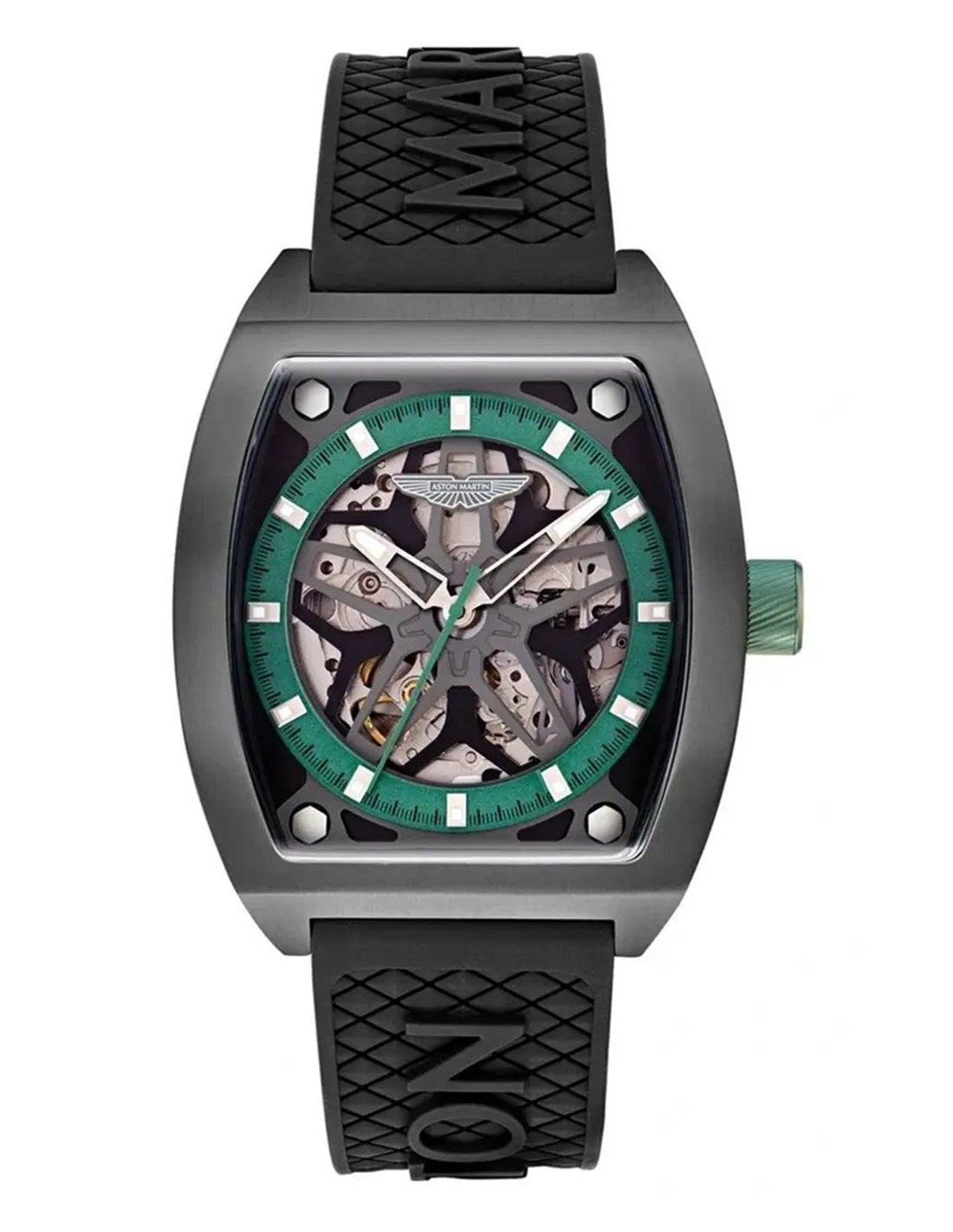
MTRT1F502 Automatic Skeleton
Here we're talking about a different conceptual league. It's not a typical skeleton, but rather an engine skeleton. Thrill, Aston Martin's watch division, has created a piece that doesn't just show the movement: it shows the inspiration. With an open design evoking a V8 engine block, a 44mm black steel case, and Aston Martin green details, this watch makes you feel like you're wearing an engine on your wrist. For those who love watches and gasoline.
View model in English →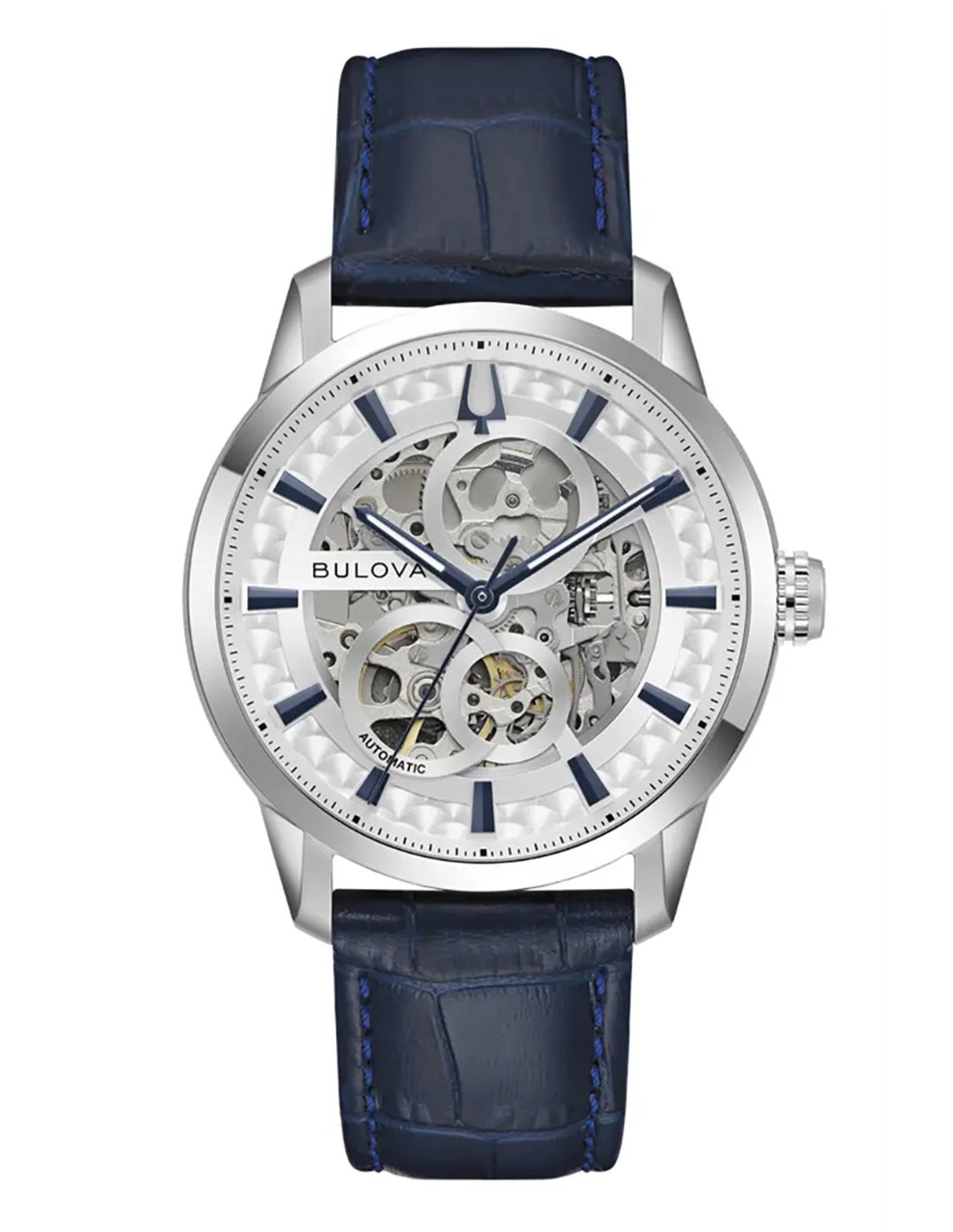
Sutton Skeleton Automatic 96A330
American with a Swiss soul. Bulova has revived its heritage with this Sutton featuring an openworked dial that reveals its 21-jewel automatic movement. A 43mm steel case, blue leather strap, and a window to the heart of the watch for under €400. A modern classic breathing history from every angle.
View model in English →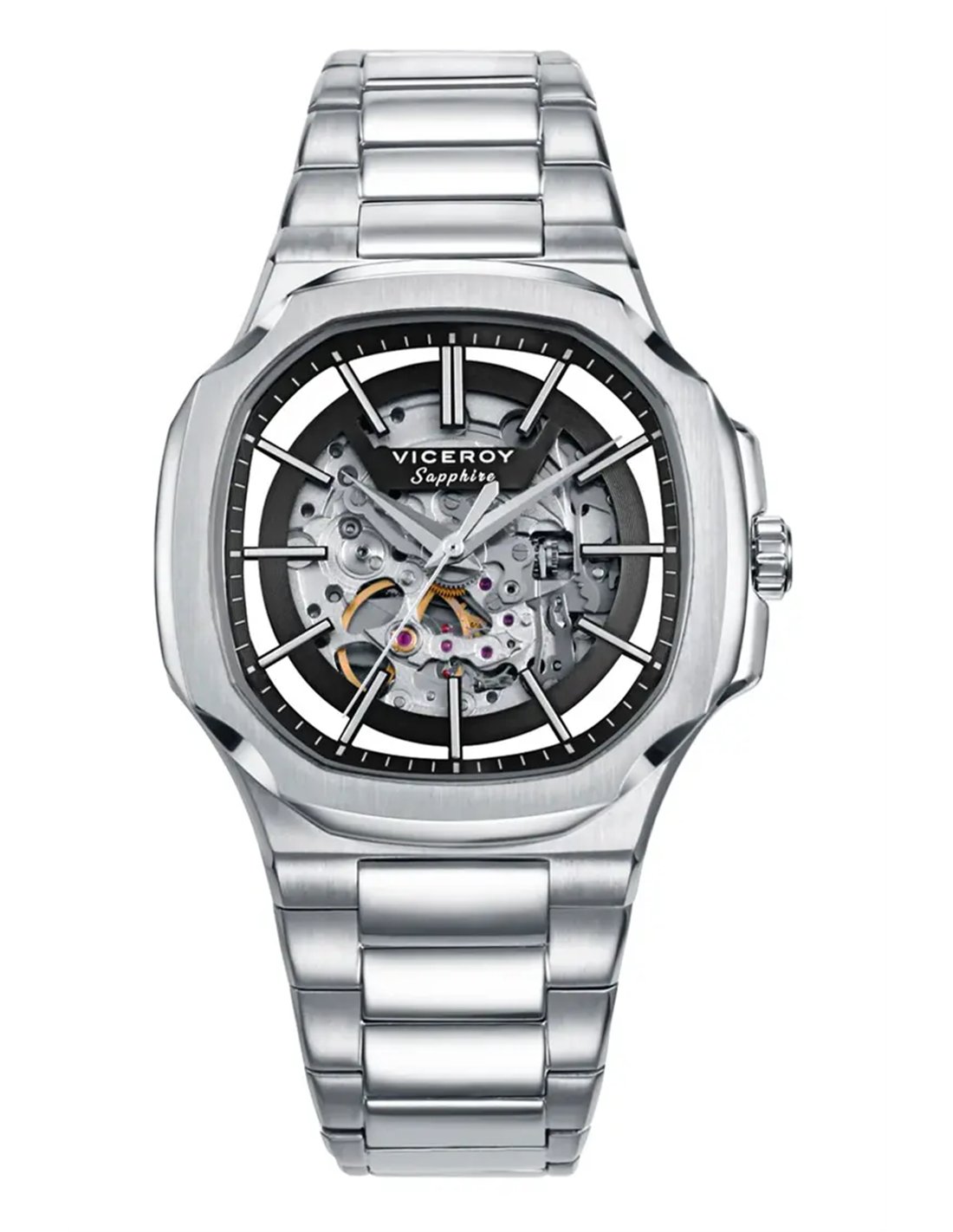
Automatic Skeleton 45113-57
Spanish design with an open soul. Viceroy brings us an automatic skeleton with a 44mm steel case, steel bracelet, and a modern, aggressive openworked dial. The movement is shown without any hang-ups, with dark-toned details and an openworked bridge reminiscent of tuning pieces. For those who want a skeleton with attitude and a tight price.
View model in English →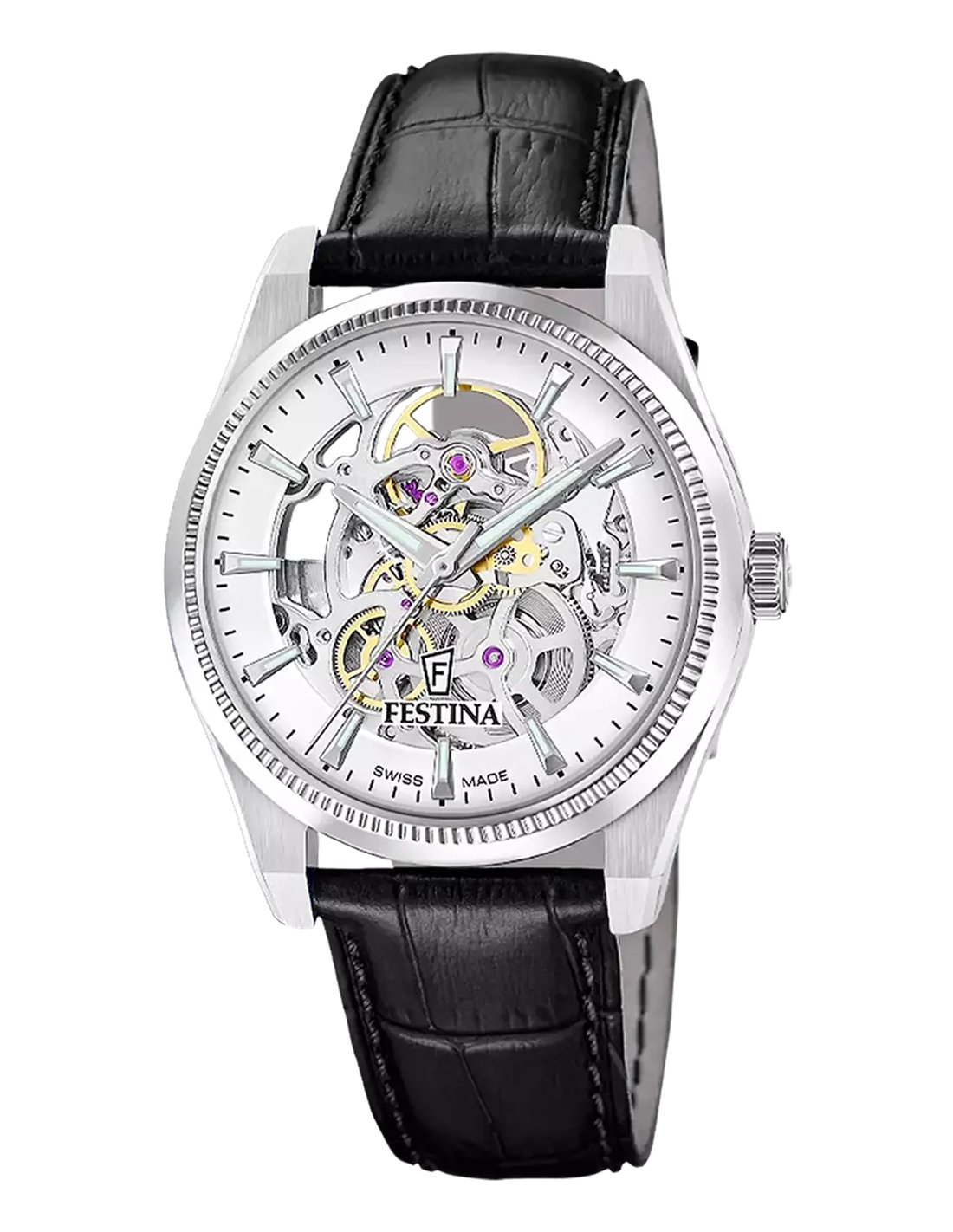
Automatic Skeleton F20095/1
This is probably the most affordable Swiss skeleton on the market. Festina, a brand with an unbeatable quality-price ratio, has managed to create a Swiss Made automatic skeleton with a 42mm steel case, sapphire crystal, and an openworked movement visible from both sides. Owning a "Swiss Made" with this level of mechanical exposure for this price is simply a market coup.
View model in English →What is the limit of the skeleton? The short answer: synthetic sapphire.
In recent years, brands like Hublot or Richard Mille have taken the concept to the extreme. They manufacture entire cases from transparent sapphire, a material surpassed in hardness only by diamond. The skeleton movement isn't just visible: it seems to levitate inside an unbreakable block of ice.
The problem? Manufacturing such a case takes months of machining and a final price that is five times that of a solid gold case.
While that dystopian (or wonderful) future arrives, enjoy your skeleton. Whether it's worth €80 or €80,000, what you wear on your wrist is the continuation of a 260-year tradition. It began in a dusty Parisian workshop with a master teaching his students. It passed through the halls of Versailles. It survived the Industrial Revolution, two world wars, and the quartz threat. And today, in the 21st century, it is still alive.
That's not a watch.
That's living history.
Not necessarily. A quality skeleton maintains the structural bridges intact and is just as robust as its closed equivalent. The risk lies in extreme openworking on very low-end watches, where too much material is removed and the movement loses rigidity. In general, avoid hard knocks with any skeleton under €500.
Very easy. In a skeleton, the dial has been completely removed or is entirely made of crystal/sapphire, allowing you to see the movement in its entirety from side to side. If you only see a small cutout in the dial revealing the balance wheel, it's an "open heart." The latter is an aesthetic detail, not full openwork. Both are valid, but don't pay the price of one for the other.
90% of the difference lies in the labor. An Orient Star or a Tissot uses industrial openwork by laser and CNC. A Vacheron Constantin or an Armin Strom involves hundreds of hours of manual labor with files, saws, and burins by an artisan with decades of experience. You are paying for time, art, and exclusivity. Not just an object.
Yes, especially for high-end pieces. Cleaning must be extremely careful not to damage the openworked edges, engravings, and bevels. A complete overhaul of a luxury Swiss skeleton can easily cost twice as much as a standard watch from the same brand.
It depends. Skeletons from the "holy trinity" of haute horlogerie (Patek Philippe, Audemars Piguet, Vacheron Constantin) not only hold their value but often appreciate over the years. Mid-range and entry-level ones (Seiko, Orient, Tissot) depreciate like any other watch in their category. Don't buy a €300 skeleton thinking of it as an investment. Buy it to enjoy it.
No. The watch case is hermetically sealed, just like a watch with an opaque dial. Dirt does not enter through the dial. The only "aesthetic" issue is that the dust inevitably generated by the movement's wear (metal micro-particles, oil) is more visible. But that just gives you an excuse to admire it more often and take it for a service when it's due.
The Skeleton in 20 Seconds
A skeleton doesn't tell you the time. It shows you the price of time. And it reminds you that beauty, sometimes, is in the bones.
Posts relacionados